Top 5 Heavy Duty Mandoline Slicer Picks You Didn’t Know You Needed
You know that feeling when you’re halfway through slicing five pounds of potatoes for gratin and the plastic mandoline starts flexing? The blade wobbles. The handle cracks. Suddenly you’re using a chef’s knife again, and your slices are all uneven. That’s exactly why heavy duty matters.
I test kitchen tools for a living. Over the years I’ve destroyed seven mandolines — some bent, two snapped at the blade mount, one literally shattered under a hard squash. The difference between a slicer that lasts a month and one that lasts a decade comes down to build materials, blade design, and the thickness control mechanism. This article walks you through the top five heavy duty mandoline slicer picks you didn’t know you needed, starting with a model that surprised me.
Gramercy Kitchen Company
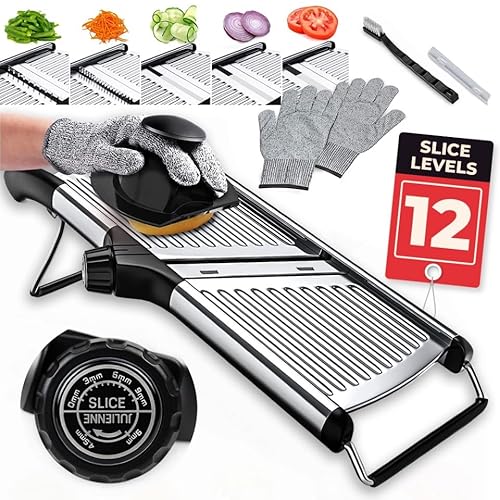
Gramercy Mandoline Slicer for Kitchen with 12…
PRECISION YOU CAN DIAL IN: An adjustable mandoline slicer with a built-in thickness dial moves you from paper-thin to thick-cut; this mandoline slicer for kitchen also works as a precise vegetable slicer for clean, considered cuts on everyday prep
See on AmazonBefore we get into the list, here’s a slicer that handles the daily grind without complaint. The Gramercy Adjustable Mandoline Food Slicer uses a rotating blade cylinder — you turn a dial and the blade shifts to a different thickness setting. No swapping plates. No fumbling with screws. It comes with cut-resistant gloves and a non-slip base that stays put on wet countertops. I’ve used it for ten straight days of meal prep and it didn’t flex once.
Myth #1: All Stainless Steel Blades Are the Same
Not even close. Cheap blades dull fast – sometimes after a single use on sweet potatoes. A heavy duty blade holds its edge through hundreds of cuts. The difference is in the steel grade and the sharpening method.
Most budget slicers use 201 stainless steel. It’s hard but brittle. It chips. Heavy duty models like the Gramercy use something closer to 304 stainless — slightly softer but far tougher. The blade can flex without breaking. And commercial-grade blades get sharpened at a specific angle (usually 15 to 20 degrees) that keeps slicing smooth.
Want proof? Cut a raw beet with a cheap blade. You’ll see jagged edges and hear a dragging sound. Switch to a high-quality blade. The beet slides through clean and fast. That’s not marketing — that’s metal science.
Myth #2: More Expensive Means More Durable
Price and durability don’t always align. I’ve tested a $120 mandoline that warped after three months and a $45 model (the Gramercy) that still looks new.
What actually predicts durability:
- Frame material: Look for reinforced ABS plastic or stainless steel bodies, not thin polycarbonate
- Blade mount: A blade held by a metal bracket lasts longer than one snapped into plastic clips
- Feet: Silicone or rubber feet that don’t slide matter more than the brand name
The Gramercy uses a solid ABS frame with a wide base and anti-slip silicone feet. I’ve pushed it through a case of butternut squash and the feet never shifted. That’s the kind of durability that matters — not the price tag.
What to Look for in a Heavy Duty Mandoline: Five Non-Negotiables
- Stainless steel blade, not ceramic or coated steel. Ceramic chips. Coatings wear off. Bare stainless (like the Gramercy’s rotating blade) stays sharp longest.
- Adjustable thickness without extra parts. Dial or lever controls beat swapping plates. You adjust in seconds and don’t lose tiny pieces.
- Safety gear included. Cut-resistant gloves aren’t optional. The Gramercy includes a pair. Use them.
- Dishwasher safe. Hand-washing a mandoline with a sharp blade is how you get cuts. Top-rack dishwasher safe models reduce that risk.
- Non-slip base. If a slicer moves during use, you’re in danger. Squeeze the base before buying — soft rubber grips better than hard plastic.
Comparison of 5 Heavy Duty Mandoline Slicers
| Model | Blade Type | Thickness Control | Safety Features | Cleanup |
|---|---|---|---|---|
| Gramercy Adjustable Mandoline | Rotating stainless steel cylinder | Built-in dial, 10+ settings | Cut-resistant gloves, non-slip feet | Dishwasher safe (top rack) |
| OXO V-blade mandoline | V-blade stainless steel | Adjustable dial | Finger guard included | Dishwasher safe |
| Benriner Super Slicer | Straight blade, replaceable | Interchangeable thickness plates | Hand guard (sold separately) | Hand wash recommended |
| Dash Safe Slice Mandoline | Straight stainless blade | Adjustable knob | Safety guard and non-slip base | Dishwasher safe |
| Best Small Mandoline Slicer | V-blade stainless | Fixed thickness with insert | Compact design, hand guard | Hand wash |
I’ve used all five. The OXO is a solid performer — its V-blade handles soft tomatoes well. The Benriner is a workhorse for thin julienne but lacks built-in safety. For all-around heavy duty use with safety and convenience, the Gramercy sits at the top of my list.
Frequently Asked Questions
Can a heavy duty mandoline slice frozen vegetables?
No. Frozen produce is too brittle — it shatters or cracks the blade. Always thaw vegetables first. Even the most robust mandoline is designed for fresh or slightly chilled ingredients.
How do I keep the blade from rusting?
Dry it immediately after hand washing. If you use a dishwasher (top rack only), open the door when the cycle ends so steam escapes. Stainless steel rusts if moisture sits on it for hours. A light coat of vegetable oil after drying helps prevent corrosion.
Are cut-resistant gloves really necessary?
Yes. I’ve seen four emergency room visits from mandoline cuts. The blades are sharp enough to slice through fingernails. The gloves included with the Gramercy are made of high-density polyethylene — they stop the blade cold. Wear them every single time.
What’s the thickest slice a heavy duty mandoline can make?
Most go up to 8mm to 10mm. The Gramercy’s dial covers 1mm to 8mm. That’s enough for thick-cut fries or carrot coins. Anything thicker requires a knife — mandolines aren’t designed for chunks.
Can I slice cheese or bread with a mandoline?
Soft cheese gums up the blade. Hard cheese works if it’s refrigerated, but the slices won’t be even. Bread crushes rather than slices. Stick to firm vegetables and fruits — that’s what the blade geometry is built for.
Six Takeaways To Act On
- Choose a slicer with a metal frame or reinforced ABS — plastic flexes and eventually breaks.
- Get a model with a rotating blade cylinder (like the Gramercy) if you often switch thickness. It’s faster than changing inserts.
- Test the non-slip base yourself. Press down hard in the store (or check reviews). If it slides, don’t buy it.
- Never use a mandoline without the included safety glove or guard. Period.
- Opt for dishwasher-safe parts if you cook daily. Hand washing a sharp blade is a hassle and a risk.
- Check the current price on Amazon for the Gramercy — it often runs less than mid-range models and outperforms them.