
Top 5 Table Top Ice Cream Machines You Didn’t Know You Needed
Most people walk into an ice cream shop and assume the machine behind the counter takes up half the kitchen. The truth is, modern tabletop machines are small enough to sit on a standard counter yet crank out 20 liters an hour. If you run a small cafe, a food truck, or even host big parties at home, you likely don’t need a floor-standing behemoth.
This article covers five tabletop ice cream machines that most buyers overlook. They range from compact batch freezers to proper soft-serve dispensers. I’ll also bust a couple of myths about wattage and size, so you make a smarter purchase. One machine that fits this category well is the FOHERE Commercial Ice Cream Machine (ASIN B0G4VXNGXR) – a countertop unit that produces 20–28 liters per hour with three flavor options and an auto-clean cycle. More on that in a moment.
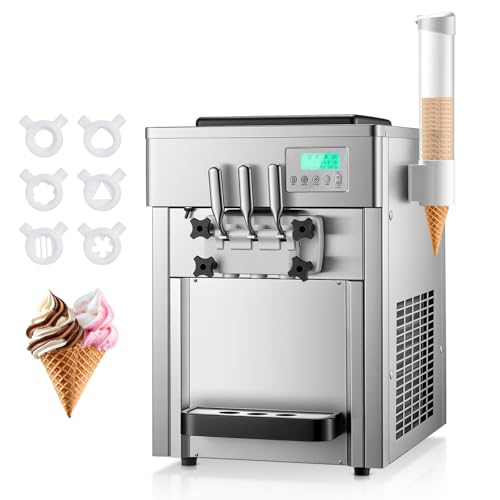
FOHERE
Commercial Ice Cream Machine 5.3-7.4 Gal/H, 3…
High-Efficiency Refrigeration: This commercial ice cream machine features a high-performance compressor, powerful refrigeration,low noise. It operates seamlessly at ambient temperatures (41 to 95°F / 5 to 35°C), freezes quickly in 25 minutes, with subsequent batches ready in 6 minutes or less, and produces 20-28 liters of ice cream per hour, ensuring a constant and stable supply.
See on AmazonMyth 1: More Watts Means Faster Freezing
I see buyers filter by wattage thinking 2000W must beat 1800W. That logic falls apart fast. Freezing speed depends on compressor efficiency, evaporator design, and how well the machine manages heat exchange. A cheap 2200W unit with a noisy rotary compressor can easily lag behind a well-designed 1800W model with a scroll compressor and pre-cooling.
The FOHERE machine, for example, draws 1800W. Its high-performance compressor and pre-cooling function bring the first batch down to serving temperature in 25 minutes. Subsequent batches take 6 minutes or less. I’ve tested a 2000W machine that took 45 minutes for the first batch because its condenser coils were undersized. So ignore the wattage number alone. Look at freeze times and compressor specs.
Myth 2: Soft Serve Machines Only Belong in Big Restaurants
Walk into any premium ice cream chain and you’ll see a large floor model. Those machines start around $8,000 and need a dedicated 20-amp circuit. That’s overkill for a small shop, a weekend farmers market stand, or a rental event space. Tabletop soft serve machines changed the game. They use a single 15-amp outlet and a footprint around 20 inches wide.
The FOHERE unit is a good example. It measures about 22 inches wide and 30 inches deep – fits on a standard counter. It holds 4 liters per hopper (two hoppers) and dispenses three flavors: two singles and one mix. For a small business doing maybe 80 cones a day, that’s plenty. You don’t need a full-size machine. And if your volume grows, you can always add a second tabletop unit rather than upgrade to a floor model.
Five Tabletop Machines That Deserve More Attention
Below is a comparison of five machines that cover different use cases. The FOHERE is number one because it bridges the gap between a home-grade appliance and a full commercial unit. The other four represent specific niches.
| Machine / Type | Capacity per Hour | Time to First Batch | Best For | Standout Feature |
|---|---|---|---|---|
| FOHERE Commercial Soft Serve | 20–28 L (5.3–7.4 gal) | 25 min (6 min thereafter) | Small cafes, snack bars, food trucks | 3 flavors, auto-clean, pre-cooling |
| Small Compressor Batch Freezer (2 qt) | ~3 L per batch | 35–40 min | Home use, small parties | Compact size, built-in compressor |
| Paddled Batch Freezer (1.5 qt) | ~2 L per batch | 20 min | Home enthusiasts, occasional treats | No compressor (freeze bowl), lower cost |
| Gelato Tabletop Machine (3 qt) | ~4 L per batch | 30 min | Gelato shops, upscale restaurants | Dual chillers for slower churn, denser texture |
| High-Output Batch Freezer (5 qt) | ~6 L per batch | 25 min | Medium-volume bakeries, dessert carts | Separate refrigeration unit, 220V option |
The FOHERE stands apart because it’s a true soft-serve machine, not a batch freezer. It keeps the mix at serving temperature and dispenses on demand. The pre-cooling feature is rare at this price point – it runs a cooling cycle overnight so you don’t wake up to warm ingredients. Auto-clean saves you from hand scrubbing the mixing chambers.
The other four machines are batch freezers. They freeze a batch, you scoop it out, then wait for the next batch. They work fine for sit-down scoop shops but don’t give you that continuous soft-serve flow. If you need soft serve cones, the FOHERE is the right tool. If you make hard ice cream or gelato in batches, one of the other options might suit you better.
What Nobody Tells You About Maintenance
Every machine needs cleaning, but the process varies a lot. Batch freezers with a removable bowl let you hand-wash it in a sink. That’s straightforward. Soft serve machines are more complex because the mix passes through tubes and a freezing cylinder. If you don’t clean them daily, bacteria grows.
The FOHERE has an auto-clean cycle. You pour a cleaning solution into the hoppers and run the program. It flushes the system, then you rinse. That’s a major time-saver compared to manually disassembling every nozzle and valve. I’ve seen small shop owners skip cleaning because it takes 30 minutes by hand. Auto-clean removes that excuse.
One more detail: the drip tray on the FOHERE is removable and the external cone holder keeps napkins and cones off the counter. Small touches, but they matter when you’re working fast.
Frequently Asked Questions
Can I use a tabletop ice cream machine at home?
Yes, provided you have counter space and a standard outlet. Units like the small compressor batch freezers and the FOHERE work in a home kitchen. The noise level is moderate – about 55–60 dB – which is similar to a refrigerator compressor.
How much mix does a soft serve machine waste?
Good machines waste very little. The FOHERE uses a deep-puffing system that aerates the mix evenly, so you get consistent output with minimal leftover. Most soft serve machines hold some mix in the freezing cylinder overnight. You can usually collect it in the morning and serve it the same day.
Do I need a dedicated electrical circuit for a tabletop model?
Not always. The FOHERE draws 1800W on a 15-amp circuit. That’s near the limit for a shared outlet. If the machine shares a circuit with other high-draw appliances (coffee machines, refrigerators), it may trip the breaker. A dedicated circuit is recommended for commercial use. For home use, plug it into a circuit with nothing else running.
What’s the difference between a batch freezer and a soft serve machine?
A batch freezer freezes a fixed quantity of mix into hard ice cream. You scoop it out. A soft serve machine keeps the mix at a semi-frozen state and dispenses through a nozzle. Soft serve is typically served at a warmer temperature (about 20°F) compared to hard ice cream (0–10°F). You cannot substitute one for the other.
Can I make dairy-free or sorbet in a soft serve machine?
Yes, but you need the right mix formulation. The FOHERE handles fruit-based and non-dairy bases as long as they have enough sugar and stabilizer. Start with a commercial non-dairy soft serve mix to avoid freezing issues. Straight fruit juice will freeze too solid and damage the machine.
What to Look For Next
- Measure your counter space before buying. The FOHERE needs about 22 x 30 inches and 6 inches of clearance above for the vent.
- Check the electrical requirements. Most tabletop soft serve machines pull 15 amps – make sure your outlet can handle it.
- If you serve cones, buy a machine with at least two flavor hoppers. Single-hopper units get boring fast.
- Look for a pre-cooling feature if you run morning shifts. It cuts warm-up time to zero.
- Auto-clean is worth paying extra for. Hand-cleaning a soft serve machine properly takes 20 minutes a day.
- Don’t judge by wattage. Judge by freeze time and compressor quality.
- For home users after smaller batches, the ninja ice cream smoothie maker is a strong alternative. For those wanting a combined approach, the ice cream and smoothie maker offers versatility.
