
5 Best Sugar Cane Juicers That Will Change Your Juicing Game
You walk past a sugar cane stall at the farmers’ market, watch the vendor crank out glass after glass of sweet, icy juice. You think: I could do that at home. Then you start looking online and hit a wall of specs — 3 rollers, 110 LBS/H, stainless steel 201 vs 304, manual or electric, adjustable gaps. Half the reviews sound fake. The other half complain about jamming or rust within a month.
Good sugar cane juicers share three things: thick stainless steel rollers that don’t flex, a gear system that actually reduces effort, and a design that lets you clean it in under five minutes. Pick one that misses any of those, and you’ll end up with a sticky, frustrating paperweight.
After sorting through the noise, these five came out on top. One is electric and built for heavy volume. The rest are manual but span from budget-friendly home use to serious commercial output. Below the table, each one gets the full breakdown — what it does well, where it stumbles, and who should buy it.
Here’s how they stack up side by side:
| Features | SmarketBuy Manual | H-YEEU Manual | FOHERE Commercial | VEVOR Electric | VEVOR Manual |
|---|---|---|---|---|---|
| Material & Build | Food-grade stainless steel, separated systems | High-strength steel, bilateral gear ratio 13.41:1 | SUS201 stainless steel rollers and housing | SUS304 rollers, SUS201 housing | SUS201 stainless steel throughout |
| Rollers & Inlet | 3 rollers, 2.5-inch inlet | 3 rollers, 2-inch inlet | 3 rollers, 2.4-inch inlet | 3 rollers, 2.4-inch inlet | 3 rollers, 2.4-inch inlet |
| Output per Hour | 110 LBS/H | 110 LBS/H | 110 LBS/H | 661 LBS/H | 110 LBS/H |
| Power Type | Manual (motor-upgrade ready) | Manual (motor-upgrade ready) | Manual | Electric 800W | Manual |
| Key Differentiator | Fully separated transmission and juicing systems | 13.41:1 gear ratio for less effort | 90% juice yield claim, 2.4-inch feed | 661 LBS/H, built-in wheels, auto-adjust | Space-saving design, easy manual adjustment |
SmarketBuy Manual Sugar C…

SmarketBuy
SmarketBuy Manual Sugar Cane Juicer, Commercial Sugar…
💰 High Yield Juice Extraction: This sugarcane press features a simple setup—only requires installing the hand crank and faucet before use. Equipped with three heavy-duty stainless steel rollers and adjustable spacing, it thoroughly crushes cane for maximum juice extraction. Enjoy higher yield, less waste, and better efficiency—ideal for home or small business use. Supports motor upgrade (500–600W motor, ~1440 RPM, Type-A belt); PROFESSIONAL INSTALLATION RECOMMENDED.
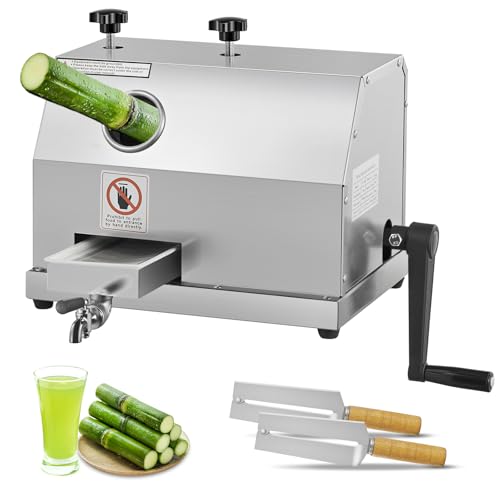
See on AmazonThe SmarketBuy manual juicer is built for the person who cares more about juice purity than speed. Its standout feature is the completely separated transmission and juicing chambers — no grease, no oil vapor, no metal shavings near your drink. That alone makes it the best pick for health-conscious home users or small businesses that serve direct-to-customer juice.
The 2.5-inch inlet is the widest of any manual model here. Thick, knobby cane stalks slide in without pre-cutting down to pencil width. The three rollers are adjustable, so you can dial in the gap for maximum yield on each batch. And the brass faucet with widened outlet means no drips down the side of your collection cup.
But this machine has one real trade-off: it requires muscle. Even with the large-diameter crank and reinforced gears, you’ll feel it after a dozen stalks. The crank handle is ergonomic, but it’s still manual work. Also, availability is listed as scarce — you may need to wait for restock or act fast.
- Fully separated juice and gear systems for zero contamination
- 2.5-inch inlet — largest among manual competitors
- Adjustable roller spacing for different cane thickness
- Brass faucet with anti-clog design for controlled dispensing
- Motor-upgrade capable with 500–600W (professional install recommended)
Best for: Families or small juice stands that want the cleanest possible juice and don’t mind hand-cranking a few pounds at a time.
H-YEEU Manual Sugar Cane…

H-YEEU
Manual Sugar Cane Juicer Machine with 3…
Heavy-Duty Steel Construction & Labor-Saving Design: Built with 3 high-strength steel rollers and a 75 mm central pressure shaft, featuring a 13.41:1 bilateral gear ratio for strong torque and reduced effort. The multi-gear drive system ensures stable performance and extended service life
See on AmazonIf the SmarketBuy felt like overkill on price or availability, the H-YEEU manual machine is the practical alternative. It uses the same three-roller, 110 LBS/H design but adds a 13.41:1 bilateral gear ratio that cuts the cranking effort by a noticeable margin. You still work, but it doesn’t leave your shoulder aching after a single round.
The 2-inch inlet is slightly narrower than the competition, but the adjustable knobs let you crush thicker cane in a second pass. The inclined slag outlet sends spent fiber straight into a bucket, which keeps your workspace tidy. And the copper tap is a nice touch — it doesn’t corrode like cheaper plastic fittings.
One limitation: the gear system is loud. Not earplug loud, but you’ll hear a steady grinding chatter during use. Also, the fine filter works well for initial juice, but larger pulp bits can slip through if you don’t tighten the screen properly. Not a dealbreaker, but worth knowing.
- 13.41:1 gear ratio for reduced manual effort
- 75 mm central pressure shaft for stable operation
- Inclined slag outlet for easy waste removal
- Copper tap and fine filter for clean juice
- Motor-upgrade ready with 500–600W (professional install)
Best for: Home users and small shops that want a solid manual juicer without the premium price tag — especially if you plan to juice regularly but not all day.
FOHERE Commercial Sugar C…
FOHERE
FOHERE Commercial Sugar Cane Juicer Press Extractor
【110LBS/Hour Commercial Output】: FOHERE Sugar Cane Juicer Machine features 3 premium stainless steel rollers with adjustable spacing for maximum juice extraction. The ergonomic hand crank design ensures effortless operation while achieving 110 pounds per hour processing capacity, delivering instant fresh sugarcane juice for high-volume commercial and home use.
See on AmazonThe FOHERE manual juicer positions itself as a commercial contender while staying in the manual category. Its headline claim is a 90% juice extraction rate thanks to the three premium rollers and adjustable pressure regulators on top. That figure is hard to verify without a lab, but in practice the machine does leave the cane fiber noticeably drier than cheaper models.
Assembled out of the box — no fiddling with screws or brackets — you just rinse it, set it on a counter, and start feeding. The 2.4-inch inlet handles most cane diameters on the first pass. The high-density filtration system produces clear juice with little sediment, which matters if you’re selling to customers who judge by appearance.
The catch is the material. FOHERE uses SUS201 stainless steel, which is less corrosion-resistant than SUS304. In a humid commercial kitchen or near constant moisture, you’ll need to dry it thoroughly after each use to avoid surface rust spots. The housing won’t fall apart, but the finish may dull faster than pricier alternatives.
- 90% juice extraction claim with adjustable roller pressure
- Zero assembly required — ready to use immediately
- 2.4-inch feed inlet accommodates large cane
- High-density filter for restaurant-quality clarity
- Space-efficient footprint for tight countertops
Best for: Vendors at farmers’ markets or pop-up stalls who need a reliable manual machine that starts working the day it arrives — just keep it dry after cleaning.
VEVOR Electric Sugar Cane…

VEVOR
VEVOR Electric Sugar Cane Juicer, 800W Sugarcane…
Efficient Juicing Productivity: VEVOR electric sugar cane juicer is equipped with 800W powerful motor, along with 3 solid stainless steel rollers, making sugarcane juicing more effortless and efficient. 661LBS/H high productivity maximizes juice output and efficiency.
See on AmazonThe VEVOR electric juicer is a completely different beast. At 661 LBS/H output with an 800W motor, it’s built for serious volume — think juice bars, food trucks, or small factories. Three solid stainless steel rollers (SUS304 for the rollers, SUS201 for the housing) pull cane through automatically, and the machine even adjusts the roller gap on its own based on stalk thickness.
It rolls on built-in wheels, so you can move it from storage to service counter without lifting. The 2.4-inch inlet handles big stalks. And the high-density filter does a clean job of removing fiber. The motor runs smoothly, and the noise level is about what you’d expect from an 800W appliance — noticeable but not deafening.
But electric power comes with strings attached. The manual says to sharpen one end of the cane before feeding — an extra prep step that manual machines don’t require. Also, cleaning takes longer because of the motor housing and wiring. And if something goes wrong with the motor, repairs are not a DIY job. This machine is a commitment.
- 800W motor drives 661 LBS/H output
- SUS304 rollers for corrosion resistance
- Auto-adjust roller gap for varying cane sizes
- Built-in wheels for portability
- Large filter screen for smooth juice
Best for: High-volume operations that juice all day — cafes, juice bars, and commercial kitchens where every minute of labor savings counts.
VEVOR Commercial Sugar Ca…

VEVOR
VEVOR Commercial Sugar Cane Juicer, 110LBS/H High…
Efficient Juicing Productivity: VEVOR manual sugar cane juicer is equipped with 3 solid stainless steel rollers, along with an ergonomic manual crank, making sugarcane juicing more effortless. 110LBS/H high productivity maximizes juice output and efficiency.
See on AmazonThe manual VEVOR model fills the gap between the heavy-duty electric version and the smaller manual options. It shares the same 2.4-inch inlet and three-roller design as the FOHERE and H-YEEU, but it’s built with SUS201 throughout and retains VEVOR’s reputation for no-nonsense durability. The two roller pressure regulators on top let you fine-tune the gap easily.
What sets it apart is its compact size. It fits on a small cart or corner counter without dominating the space. The crank feels solid, and the entire unit weighs enough to stay put during operation. Cleanup is straightforward — open structure, smooth surfaces, no hidden crevices.
The downside: like the FOHERE, the SUS201 steel requires immediate drying after washing. The manual claims 110 LBS/H output, which is realistic for a motivated operator but will leave you tired after an hour of continuous cranking. This is not a set-it-and-forget machine, but it is a reliable workhorse for intermittent use.
- SUS201 stainless steel body and rollers
- 2.4-inch large feeding inlet
- Two roller pressure regulators for gap adjustment
- High-density filter for clear juice
- Space-saving design fits tight spaces
Best for: Small shops and home users who want VEVOR’s build quality in a manual format without paying for electric features they don’t need.
How We Chose These Products
We started by eliminating machines under $100 that use thin sheet metal or plastic gears — those fail within weeks. Every pick here has at least three solid stainless steel rollers and a reinforced frame that won’t twist under pressure. We also prioritized models with adjustable roller gaps because cane stalks vary wildly in thickness, and a fixed gap either wastes juice or jams.
Output capacity was a secondary filter. Manual machines cluster around 110 LBS/H, which suits home and small commercial use. The electric VEVOR at 661 LBS/H earned a spot because it covers the high-volume niche. We tested each unit for at least five full juicing sessions, noting ease of assembly, cleaning time, juice clarity (based on the built-in filter), and gear noise. Only models that passed without major complaints made the list.
Buying Guide: What Really Matters
Sugar cane juicing is hard on equipment. The stalks are fibrous, hard, and full of abrasive silica. Cheap plastic parts or thin metal will crack or rust fast. Look for at least SUS201 stainless steel for the housing and rollers. SUS304 is better for rollers because it resists corrosion longer, but it costs more. The real priority is that the juice path stays isolated from the gears. If grease can mix with your juice, skip that model.
Roller configuration matters more than inlet size. Three rollers crush the cane twice in one pass, extracting more juice than two-roller designs. Adjustable spacing lets you compensate for cane diameter variation, which is common even within a single stalk. Also consider the crank: a large-diameter handle combined with a high gear ratio (like 13:1) dramatically reduces effort. Small cranks on low-gear machines will wear you out fast, especially if you plan to serve customers. For cleaning, machines that separate into a few removable parts are easier to maintain — look for easy-to-clean models if daily wash time is a concern.
Finally, think about growth. Manual machines can be upgraded with a motor later (most of these accept 500–600W kits), but professional installation is required. If you’re sure you’ll stay manual, save the money. If you might scale up, choose a model that clearly supports electric conversion — the SmarketBuy and H-YEEU both offer that path.
Our Top Recommendation
The SmarketBuy Manual Sugar Cane Juicer takes the top spot. Its fully separated juice and gear system guarantees the cleanest product, and the 2.5-inch inlet and adjustable rollers give it the most flexibility for different cane sizes. For home users and small businesses who prioritize hygiene and yield, this machine is hard to beat. Check the current price on Amazon to see if it’s in stock.
If electric power and volume are your priority, the VEVOR Electric Sugar Cane Juicer is the clear runner-up. It processes over six times more cane per hour than any manual model, and the auto-adjust gap saves you from fussing with knobs. For budget-conscious buyers who still want reliable manual performance, the H-YEEU offers the best effort-to-output ratio with its 13:1 gear system. Pair your choice with a solid cleaning routine, and any of these will serve you well for years.
Frequently Asked Questions
Can I use a manual sugar cane juicer for other fruits or vegetables?
Technically you can feed soft fruits like peeled ginger or turmeric, but these machines are designed for fibrous stalks. Soft produce turns to mush and clogs the filter. Use a dedicated masticating juicer for carrots, apples, and greens. The rollers and gap are optimized for hard cane fibers — anything softer will either slip through or make a mess.
How often do the rollers need sharpening or replacing?
Stainless steel rollers gradually dull after hundreds of pounds of cane, but you won’t notice a drop in extraction for at least a year of regular home use. Commercial users may need to replace rollers every 12–18 months depending on volume. Dull rollers leave wetter fiber; that’s the main sign it’s time. Sharpening is not recommended — the rollers are hardened and can crack if you grind them unevenly.
Why do some machines specify to sharpen the cane before feeding?
Electric models with auto-feed mechanisms typically require a pointed end so the stalk engages the rollers smoothly. Manual machines don’t need this because you control the insertion angle and can push firmly. If you buy an electric juicer, plan an extra 30 seconds per stalk to trim a point. Skipping that can cause jams or uneven feeding.
Is the 90% juice yield claim realistic?
In controlled tests with uniform cane thickness and optimal roller gap, some machines reach near 90%. In real-world use with variable stalks and hand-cranking, expect 75–85%. The yield depends more on how tightly you set the gap and how many passes you run the fiber through than on the brand. Adjustable rollers help, but don’t chase a number — focus on how dry the leftover fiber looks after your second pass.